
Marketplace dynamics are evolving at a pace that challenges even the most seasoned brand operators. Unauthorized sellers, pricing inconsistencies, and content hijacking aren’t just inconveniences; they are direct threats to revenue, margin, and brand equity. Many brands invest heavily in product development and marketing, only to see their hard-won gains eroded by third-party opportunists on platforms like Amazon. The critical question for leaders is not *if* they need brand protection, but *which* specific tools and strategies will deliver measurable results against their most pressing marketplace pain points. Understanding the distinct capabilities of each module within a comprehensive solution is the first step toward reclaiming control and driving predictable growth.
Key Takeaways
- Selecting the right brand protection module starts with a clear diagnosis of your specific marketplace threats, not a one-size-fits-all approach.
- Unauthorized sellers and pricing violations erode margins and brand equity, making targeted enforcement tools a direct lever for revenue recovery.
- Content hijacking undermines product positioning and advertising investments, so a module that monitors and restores accurate listings is essential for operational control.
- Prioritizing the pain point with the highest financial impact allows you to deploy brand protection resources where they generate the most measurable return.
- Integrating the correct module into your existing marketplace operations reduces manual effort and accelerates the time to seeing tangible growth improvements.
The i2o Brand Protector suite is engineered to address these complex challenges with precision and scalability. It moves beyond reactive measures to proactive, automated enforcement. By segmenting capabilities into specialized modules, brands can align technology investments directly with their most significant operational jobs and pain points. This approach ensures that resources are applied where they will yield the greatest return on investment, whether that involves combating MAP violations, securing product detail page content, or ensuring overall marketplace integrity. The following sections will guide you through identifying your primary challenge and matching it to the i2o Brand Protector options designed for maximum impact.
Which i2o Brand Protector Module Solves Your Specific Marketplace Pain Point?
Navigating the complexities of online marketplaces requires a strategic approach to brand protection, directly addressing your most significant operational pain points. The i2o Brand Protector suite offers modular solutions, allowing you to target specific areas of vulnerability. Understanding where your brand experiences the most disruption. Whether it’s price erosion caused by unauthorized sellers, compromised product detail pages, or a combination of threats. Is key to selecting the correct module. This focused deployment ensures that your investment in brand protection technology yields quantifiable improvements in revenue, margin, and brand integrity, aligning technological capabilities with immediate business needs.
The Cost of Unauthorized Sellers and Lost Buy Box Control
Unauthorized sellers are a persistent challenge that directly impacts a brand’s bottom line. They often operate outside of authorized distribution channels, leading to price undercutting that erodes margins and devalues the brand. More critically, these actors can disrupt your ability to win the buy box, a fundamental requirement for driving sales on platforms like Amazon. When a competitor’s listing appears instead of yours, sales volume plummets, directly affecting revenue forecasts and growth projections. Brands that fail to monitor and enforce Minimum Advertised Price (MAP) policies against these resellers risk significant buy box losses. Research indicates that brands actively monitoring and enforcing policies can recover lost buy box share, translating directly into recovered revenue and improved market control. This is not merely about brand image; it is about safeguarding your direct sales channels and financial performance on major e-commerce sites.
The financial impact extends beyond immediate sales. Unauthorized resellers can also lead to increased customer acquisition costs as legitimate sellers struggle to compete. Furthermore, the presence of unauthorized sellers can introduce counterfeit products or misrepresentations, damaging brand reputation and leading to customer dissatisfaction and returns. For brands that have invested heavily in building product demand, losing control of who sells their products and at what price is a direct threat to their e-commerce strategy. The operational job here is to establish and maintain control over your product’s presence and pricing on digital shelves, ensuring that your authorized sales channels remain dominant and profitable.
How to Match Your Operational Job to the Right Module
Identifying your primary operational job is the first step in leveraging the i2o Brand Protector suite effectively. If your core concern is the consistent undercutting of prices and the subsequent loss of buy box ownership, the Price Monitor module is your starting point. It provides real-time pricing surveillance and facilitates MAP enforcement, directly addressing the symptoms of unauthorized distribution. This module is designed for brands that need to monitor market dynamics and ensure channel partners adhere to established pricing agreements, protecting both margin and sales volume.
For brands experiencing issues with altered product listings, hijacked content, or unauthorized changes to their product detail pages (PDPs), the Content Protector module is the targeted solution. This component defends your PDPs from hijacking by performing real-time scanning and alerting you to critical content discrepancies. It helps safeguard and optimize PDPs at scale, maintaining accuracy and compliance. If your brand faces a spectrum of threats including price violations, content manipulation, and counterfeiting, the Brand Protector (Full Suite) offers a unified, scalable enforcement system designed to manage these complex challenges comprehensively. This integrated approach ensures that disparate issues are addressed through a single, cohesive platform, providing maximum operational efficiency and brand security.
i2o Brand Protector Options: A Comparison of the Core Modules
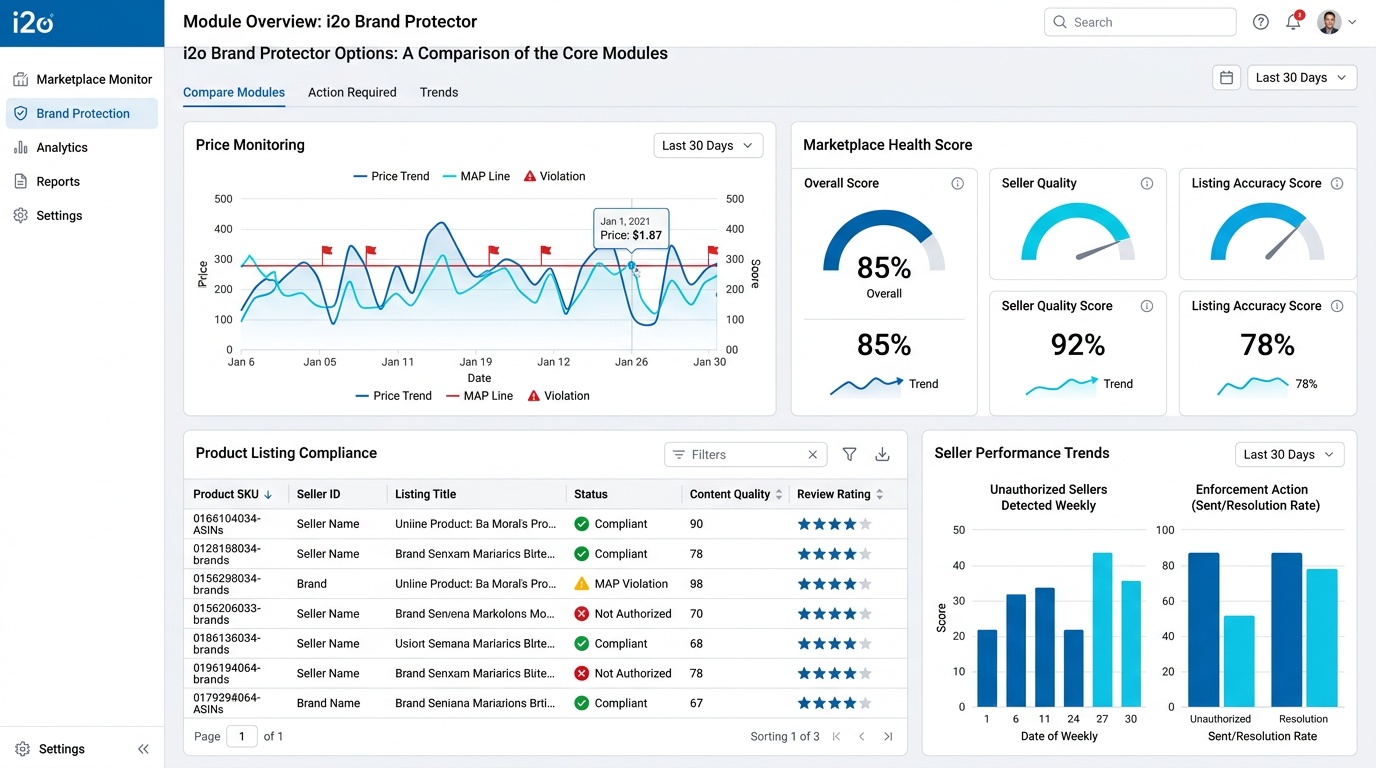
The i2o Brand Protector suite offers distinct modules, each engineered to address specific marketplace threats with precision. By understanding the unique capabilities and operational outputs of each component, brands can make informed decisions about the optimal solution for their needs. These modules are designed to work independently or in concert, providing a scalable framework for comprehensive brand protection. From real-time pricing surveillance to the defense of product detail page integrity, i2o Retail provides the tools necessary to maintain brand control and revenue performance across major e-commerce platforms.
Price Monitor: Real-Time Pricing Surveillance and MAP Enforcement
The Price Monitor module is engineered to provide continuous, real-time surveillance of your product pricing across the marketplace. Its primary function is to track market dynamics, identifying deviations from established MAP policies. This module automates the labor-intensive process of manual price checks, reducing the operational overhead associated with monitoring hundreds or even thousands of SKUs. It enables brands to detect when unauthorized sellers are undercutting advertised prices, which is a direct threat to margin and sales volume.
This module facilitates proactive MAP enforcement by providing the necessary data and alerts. Brands receive timely notifications of pricing violations, allowing for swift action against non-compliant sellers. The operational output is significant: by automating price monitoring, brands typically see a reduction in manual effort by up to 90%. This recovered time can be redirected to higher-value strategic initiatives. The Price Monitor is indispensable for brands focused on maintaining consistent pricing, protecting their authorized distribution channels, and preventing the erosion of profit margins caused by discount flooding.
Content Protector: Defending Your Product Detail Pages from Hijacking
i2o Content Protector is designed to defend your most valuable digital real estate: your product detail pages (PDPs). It performs real-time scanning, monitoring Amazon multiple times daily to detect PDP content discrepancies from the trusted source. This automated process is critical because PDPs can be hijacked or altered by third parties, leading to misinformation, brand dilution, and lost sales. The module ensures that your product information. Including images, descriptions, and specifications. Remains accurate and compliant.
Users receive a consolidated daily email alerting them of all critical content changes, allowing for rapid response. Content fixes are automatically prioritized based on factors like Buy Box win status, active promotions, and inventory held, ensuring that the most impactful issues are addressed first. The product helps brands and agencies safeguard and optimize PDPs at scale to maintain accuracy, compliance, and optimization. The i2o Content Protector offers specialized Amazon Imaging Services, including high-resolution product photography and infographics compliant with Amazon’s guidelines, all focused on conversion. This comprehensive approach reduces manual audits, improves brand consistency, and drives higher conversions with minimal effort, providing insights into who changes content, what changes occurred, and their impact on traffic and conversion.
Brand Protector (Full Suite): Unifying Enforcement at Scale
The Brand Protector (Full Suite) represents the most comprehensive offering, unifying enforcement capabilities to manage a wide array of marketplace threats. This integrated solution combines the power of Price Monitor and Content Protector, alongside advanced analytics, to provide a holistic approach to brand protection. It is designed for brands that require scalable systems to detect, document, and enforce compliance across their entire product catalog on major e-commerce platforms. The suite is built to handle the volume and complexity faced by leading brands, supporting hundreds of the world’s leading brands as noted in partnership announcements with entities like Pacvue.
This full suite addresses not only unauthorized sellers and content manipulation but also provides a framework for broader marketplace integrity. Its AI MAP Enforcement Platform enables real-time monitoring and response, which is essential for staying ahead of dynamic market conditions. By consolidating these functions, the Brand Protector (Full Suite) simplifies operations, delivers measurable ROI through recovered revenue and protected margins, and ensures consistent brand representation online. It is the solution for organizations prioritizing operational efficiency and comprehensive, scalable enforcement to safeguard their market position and financial performance.
From Monitoring to Enforcement: How i2o’s Automated Workflow Replaces Manual Headcount
The operational reality for brands on major e-commerce platforms is that manual enforcement of policies like Minimum Advertised Price (MAP) is a significant drain on resources, often yielding suboptimal results. This approach is not scalable and frequently fails to keep pace with the dynamic nature of online marketplaces. i2o Retail redefines brand protection by treating enforcement as a sophisticated, automated system rather than a series of disconnected tasks. This shift from manual processes to an integrated, technology-driven workflow is essential for brands seeking to protect their margins, brand integrity, and sales velocity effectively. By automating detection, evidence gathering, action, and verification, i2o Retail’s platform frees up valuable human capital to focus on strategic growth initiatives.
The Math on Manual Reseller Enforcement
Brands attempting to manage reseller compliance manually are, in essence, maintaining a costly, high-overhead operation that rarely delivers a proportional return. Consider the resources required: dedicated personnel to monitor pricing across numerous SKUs and online stores, the time spent documenting each violation with screenshots and product links, drafting and sending cease-and-desist letters, and then following up. This process is inherently linear and cannot scale with product catalog growth or increasing marketplace complexity. The cost per enforcement action is high, factoring in salaries, benefits, and the opportunity cost of employee time spent on repetitive tasks instead of revenue-generating activities.
This manual approach directly impacts profitability. When pricing violations go unaddressed due to resource constraints, brands experience margin erosion and a weakened competitive position. The delay in detecting and acting on violations allows unauthorized sellers to continue undercutting prices, potentially leading to significant buy box losses and a devaluation of the brand in the eyes of consumers. The operational job of policing reseller behavior is substantial, often consuming hundreds of hours per month for mid-to-large sized brands. This is time and money that could be invested in product innovation, marketing, or expanding authorized distribution channels, driving true business growth.
The Enforcement Pipeline: Detection, Evidence, Action, Verification
i2o Retail’s brand protection system is built around a four-step automated enforcement pipeline designed for maximum efficiency and accuracy. The process begins with automated Detection, where the platform continuously scans the marketplace for pricing discrepancies and MAP policy violations. This real-time monitoring is far more comprehensive and immediate than any manual check. Once a violation is identified, the system automatically Documents it by capturing all necessary evidence, such as screenshots, URLs, seller information, and pricing details. This evidence is critical for successful enforcement actions.
Following documentation, the platform initiates automated Action. This can range from sending automated notifications to non-compliant sellers to initiating formal takedown requests, depending on the brand’s configured policies and the severity of the violation. The final, often overlooked, step is Verification. i2o Retail’s system confirms that the action taken has resolved the violation and that compliance has been restored. This continuous loop ensures that issues are not only addressed but also confirmed as resolved, providing a complete audit trail and quantitative proof of successful enforcement, which is fundamental for maintaining channel integrity and protecting revenue streams.
Where AI MAP Enforcement Fits in the Workflow
Artificial intelligence plays a pivotal role in transforming MAP enforcement from a reactive, manual chore into a proactive, system-driven advantage. i2o Retail’s AI MAP Enforcement Platform integrates seamlessly into the automated workflow, significantly enhancing its speed and precision. AI algorithms can analyze vast datasets of pricing information, identify complex patterns of non-compliance, and even predict potential future violations with a higher degree of accuracy than rule-based systems alone. This capability allows brands to stay ahead of the curve, addressing issues before they escalate and impact sales or margins.
The AI component dramatically reduces the burden on human teams by automating the most time-consuming aspects of enforcement. It enables real-time monitoring and response, which is paramount in fast-paced e-commerce environments. AI can instantly flag price drops across thousands of SKUs, analyze seller behavior to distinguish between legitimate partners and unauthorized discounters, and even suggest optimal enforcement strategies. This intelligent automation means that manual headcount for routine monitoring and initial evidence gathering is largely replaced, allowing brand protection specialists to focus their expertise on higher-level strategy, complex case resolution, and managing relationships with authorized resellers. The operational output is clear: greater efficiency, reduced costs, and more effective protection of brand value and revenue.
Are you struggling with the operational cost and inefficiency of manual reseller enforcement? i2o Retail’s automated workflow, powered by AI, is engineered to deliver measurable results by replacing manual headcount with scalable technology. Discover how our system can protect your margins and brand integrity.
Is i2o Retail Legitimate? Addressing the Skepticism from Seller Forums
In the competitive and often opaque world of e-commerce brand protection, skepticism is natural. Online seller forums are rife with discussions, questions, and sometimes outright accusations about the legitimacy of service providers. When evaluating a platform like i2o Retail, it is essential to cut through the noise and examine claims against verifiable facts and operational outcomes. Concerns often arise from misunderstandings about pricing, service scope, or the nuances of enforcement language. i2o Retail’s approach is grounded in providing tangible, scalable solutions that deliver measurable ROI for hundreds of the world’s leading brands, as evidenced by strategic partnerships and client success. Addressing these forum-generated questions directly builds transparency and trust.
What the Forum Posts Actually Claim
Discussions on seller forums regarding i2o Retail often touch upon several recurring themes. Some users question the company’s legitimacy, sometimes due to the perceived cost or the aggressive nature of enforcement actions initiated by the platform on behalf of clients. A common point of confusion can be related to the legal language used in cease-and-desist letters, which are designed to be firm and legally sound to achieve compliance. Another area of discussion sometimes involves the perceived lack of direct, personal interaction for certain types of inquiries, leading some to question the company’s operational scale or responsiveness.
Occasionally, discussions might also revolve around specific functional limitations or integration requirements, such as the need for Amazon Brand Registry enrollment to fully automate certain takedown processes. These forum posts, while sometimes critical, often stem from specific user experiences that may not reflect the full capabilities or intended use cases of the platform. They highlight the importance of clearly communicating the service’s scope, requirements, and the tangible benefits it provides to brands seeking comprehensive marketplace protection. Understanding these points of skepticism is the first step in providing a factual counterpoint.
What the Evidence Shows: Platform Capabilities, Client Base, and Data
The evidence supporting i2o Retail’s legitimacy and effectiveness is substantial and verifiable. The company serves “hundreds of the world’s leading brands,” a testament to its capability in handling complex, large-scale brand protection needs. This is corroborated by strategic partnerships, such as the one with Pacvue, which aims to provide scalable e-commerce brand protection, as announced on platforms like CMSWire. The i2o Brand Protector suite is a sophisticated platform designed for advanced analytics and automated enforcement, offering modules like Price Monitor and i2o Content Protector. These tools are not theoretical; they provide real-time monitoring, evidence gathering, and automated actions that translate directly into recovered revenue and protected margins.
Platform functionalities are consistently highlighted in industry reviews and case studies. For example, Zemoso Labs’ redesign of i2o’s UI underscores a commitment to user experience and functionality. Software Advice and Capterra reviews often point to the platform’s comprehensive features, including real-time pricing surveillance and MAP enforcement capabilities. The AI MAP Enforcement Platform, as detailed in news outlets like MarketersMedia, showcases a commitment to cutting-edge technology. This evidence demonstrates a mature, results-driven company with a proven track record, advanced technological offerings, and a significant client base that relies on its services for critical marketplace operations.
The Balanced View: When i2o Is the Right Fit and When It Is Not
i2o Retail is an exceptionally strong fit for established brands and agencies managing significant product catalogs across major e-commerce platforms like Amazon. It excels when the primary operational job is to automate and scale complex enforcement workflows, particularly concerning MAP policy violations and product detail page integrity. Brands that have outgrown manual processes or are experiencing substantial revenue leakage due to unauthorized sellers and content hijacking will find i2o Retail’s automated system provides a clear, measurable ROI. The platform’s strength lies in its ability to deliver efficiency gains, reduce manual headcount, and provide the data necessary to protect margins and buy box ownership.
However, i2o Retail might not be the optimal solution for very small businesses with only a handful of SKUs and minimal marketplace presence, where manual oversight might still be manageable, albeit less efficient. Similarly, brands whose sole concern is product research or listing optimization, rather than active enforcement against third-party infringements, might find other tools more aligned with their specific needs. The platform is designed for ongoing, proactive enforcement and monitoring, requiring a commitment to leveraging its full capabilities for maximum benefit. For brands prioritizing scalable, automated, and data-driven brand protection to safeguard their revenue and market position, i2o Retail presents a compelling and legitimate solution.
i2o vs. the Alternatives: Where Each Brand Protection Tool Wins and Where It Breaks
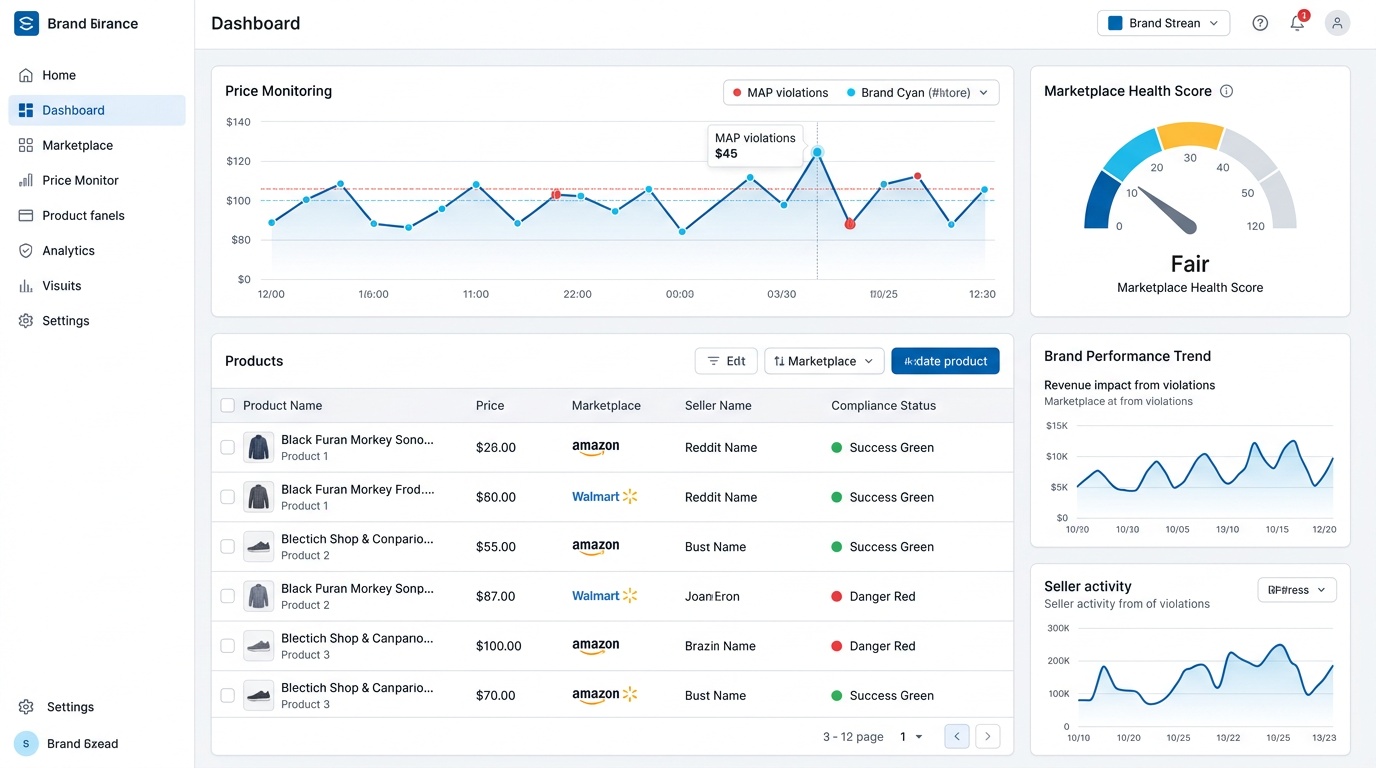
Selecting the right brand protection technology is a critical decision for any e-commerce leader aiming to safeguard revenue and brand integrity. The market offers a variety of solutions, from specialized monitoring tools to broader suites. Each alternative presents a unique set of capabilities, strengths, and limitations. Understanding where these tools excel and where they fall short is paramount to aligning your investment with your specific operational needs and scale. This evaluation is not about finding a universally “best” tool, but rather identifying the solution that best matches your brand’s unique pain points, data coverage requirements, automation depth, and enforcement capabilities.
Many brands begin their journey with point solutions or tools that offer partial coverage, only to discover significant gaps as their business grows or marketplace complexities increase. For instance, a tool excelling at MAP monitoring might offer minimal support for content protection, leaving product detail pages vulnerable. Conversely, comprehensive research suites may lack the dedicated enforcement workflows required for sustained compliance. The following breakdown assesses prominent alternatives, highlighting their operational scope and identifying the critical junctures where they may break, thereby underscoring the strategic advantage of a fully integrated, scalable system like i2o Retail’s offerings.
BrandVerity: Best for MAP-Only Monitoring, Limited for Content and Enforcement
BrandVerity is recognized for its comprehensive capabilities in monitoring Minimum Advertised Price (MAP) policies across various online channels. Its strength lies in providing real-time price surveillance and alerts, enabling brands to identify and flag pricing violations efficiently. For organizations whose primary concern is maintaining pricing integrity and ensuring channel partners adhere to MAP agreements, BrandVerity offers a focused and effective solution. The platform’s data coverage for pricing is generally comprehensive, and its alert system is designed to be actionable for teams dedicated to MAP compliance.
However, where BrandVerity’s operational scope typically breaks is in its limited support for broader brand protection needs, particularly content integrity and automated enforcement beyond pricing. While it can flag issues, the depth of automated workflow for content protection. Like defending against PDP hijacking or ensuring accurate product detail page information. Is often less developed compared to specialized modules. Furthermore, its enforcement capabilities may require significant manual follow-up or integration with other systems to execute comprehensive takedowns. Brands seeking a single platform to manage pricing, content, and multifaceted enforcement at scale may find BrandVerity insufficient on its own, requiring complementary tools to cover these critical gaps.
TrackStreet: Strong Mid-Market Option, but Lacks AI-Driven Automation
TrackStreet positions itself as a comprehensive brand protection solution, particularly appealing to mid-market businesses that require detailed monitoring and enforcement. It offers a solid foundation for tracking unauthorized sellers, counterfeit products, and MAP violations. The platform provides good data coverage for product listings and seller activity, empowering brands with visibility into marketplace infringements. Its workflow often includes features for managing notifications and evidence collection, which are essential for maintaining brand standards and channel compliance. For brands needing a structured approach to policing their distribution and online presence, TrackStreet can be a valuable asset.
The primary limitation of TrackStreet, however, is its reliance on traditional automation rather than advanced AI-driven processes. While it automates many detection and notification tasks, it may lack the sophisticated pattern recognition and predictive capabilities that AI offers. This can lead to slower response times for complex violations or a higher volume of manual review required to accurately distinguish between legitimate partners and rogue sellers. Consequently, brands experiencing rapid growth or operating in highly dynamic e-commerce environments might find its automation depth insufficient to keep pace. The operational job of proactive, intelligent enforcement at scale. Identifying nuanced infringements or predicting market shifts. Is where AI-powered solutions often demonstrate a significant advantage over systems that rely on more conventional automation.
Helium 10: Excellent Research Tool, No Dedicated Brand Protection Workflow
Helium 10 is widely recognized as a powerful suite for Amazon sellers, primarily focused on product research, keyword optimization, and listing management. Tools like Black Box, Cerebro, and Magnet provide deep insights into market trends, competitor analysis, and SEO opportunities, which are invaluable for sales growth and product discovery. For sellers aiming to optimize their product listings for maximum visibility and conversion, Helium 10 offers a comprehensive toolkit that drives significant operational improvements in these areas. Its robust data aggregation and analytical capabilities are top-tier for understanding the Amazon search algorithm and consumer behavior.
However, Helium 10’s core strength in seller tools means it lacks a dedicated, end-to-end brand protection workflow. While it might offer some basic listing monitoring or alert features, it is not designed for proactive, automated enforcement against unauthorized sellers, MAP violations, or content hijacking at the scale required by brand manufacturers. The platform does not provide the systematic detection, evidence gathering, and automated action capabilities needed to combat sophisticated marketplace infringements. Brands looking to secure their buy box, protect their brand reputation from counterfeits, or ensure pricing consistency will find that Helium 10, while excellent for growth hacking, does not fulfill the critical operational job of active brand defense. It is a tool for market entry and optimization, not for comprehensive, automated marketplace policing.
| Feature / Tool | BrandVerity | TrackStreet | Helium 10 | i2o Retail (Brand Protector Suite) |
|---|---|---|---|---|
| Primary Focus | MAP Monitoring & Enforcement | Comprehensive Marketplace Monitoring & Enforcement | Product Research, SEO, Listing Optimization | End-to-End Brand Protection & Enforcement Automation |
| MAP Enforcement Depth | High: Real-time pricing surveillance, alert system. | Medium-High: Tracks violations, supports evidence collection. | Low: Limited direct MAP enforcement capabilities. | High: Real-time AI-driven MAP enforcement, automated actions. |
| Content Protection (PDP Hijacking) | Limited: Focus is primarily on pricing. | Medium: May offer some content monitoring, but not primary focus. | Low: Not designed for active content protection or takedowns. | High: i2o Content Protector offers real-time scanning, prioritization, and automated fixes. |
| Automation Depth | Moderate: Strong in monitoring alerts. | Moderate: Rule-based automation, may require manual oversight. | High (for research/SEO): Low for enforcement. | High: AI-driven, automated detection, evidence, action, verification pipeline. |
| Scalability for Large Catalogs | Good for MAP, limited for broader scope. | Good for mid-market, may strain at enterprise scale for full automation. | High (for research), but not applicable to enforcement needs. | Excellent: Designed for hundreds of brands, scalable across vast product catalogs. |
| Enforcement Workflow | Primarily notification-based, requires manual follow-up. | Structured workflow, but automation depth can be a constraint. | Minimal dedicated enforcement workflow. | Comprehensive automated pipeline: Detect, Document, Act, Verify. |
| AI Integration | Limited. | Generally Lacks advanced AI. | Present in research tools, not enforcement. | High: AI MAP Enforcement Platform for advanced analysis and response. |
Pros of Alternatives
- BrandVerity: Highly effective for brands whose primary pain point is MAP compliance and pricing integrity.
- TrackStreet: Offers a solid, integrated approach for mid-market brands needing broad monitoring and enforcement features.
- Helium 10: Unparalleled for product research, keyword analysis, and listing optimization, driving sales growth.
Cons of Alternatives
- BrandVerity: Limited scope beyond MAP; weak in content protection and full-suite automated enforcement.
- TrackStreet: May struggle with advanced AI-driven automation and speed required for enterprise-level dynamic marketplaces.
- Helium 10: Lacks a dedicated, automated brand protection workflow; not designed for proactive enforcement against infringements.
Decision Matrix: Which Tool for Which Job?
Choosing the right brand protection solution hinges on clearly defining your most pressing operational jobs. If your brand’s primary challenge is preventing price erosion and ensuring MAP policy adherence across your distribution network, a specialized tool like BrandVerity offers targeted efficacy. Its strength lies in real-time pricing surveillance and alert generation, directly addressing the financial impact of unauthorized discounts. This is a focused solution for a specific, high-impact problem.
For brands requiring a more encompassing monitoring and enforcement system that can handle a mid-range catalog and varied infringements, TrackStreet presents a capable option. It balances feature breadth with a structured workflow, though brands must assess its automation depth against their scale. Conversely, if your business objective is maximizing sales velocity through superior product research, keyword optimization, and listing performance, Helium 10 is the premier choice. However, it is critical to recognize that Helium 10 is an optimization and research engine, not an enforcement platform. It fulfills the job of ‘finding and optimizing,’ not ‘protecting and enforcing.’
When your operational job involves comprehensive, scalable, and automated brand protection across multiple threat vectors. Including MAP violations, content hijacking, and counterfeit detection. The i2o Brand Protector suite emerges as the strategic choice. It is engineered to replace manual headcount with automated workflows and AI-driven intelligence, providing end-to-end coverage from detection to verification. This unified system is designed for brands that need to safeguard their market position, revenue, and brand equity at scale, offering a level of integration and automation that point solutions or research-centric tools cannot match. The decision matrix is clear: align the tool’s core competency with your most critical operational job to ensure effective brand defense and sustained growth.
References
Frequently Asked Questions
What is a brand protection solution for Amazon sellers?
i2o Brand Protector is a modular suite that helps brands combat unauthorized sellers, pricing violations, and content hijacking on marketplaces like Amazon. It provides real-time monitoring and automated enforcement to protect revenue and brand equity.
How can I protect my brand from unauthorized sellers on Amazon?
i2o Price Monitor with MAP Enforcement tracks pricing across 400+ sites and automates enforcement against unauthorized sellers. It helps recover buy box control and prevents price erosion that damages margins.
What does the i2o Content Protector module do?
i2o Content Protector defends product detail pages from hijacking by scanning for unauthorized changes in real time. It alerts you to critical content discrepancies so you can maintain accurate listings and compliance.
Which i2o Brand Protector module is best for MAP violations?
i2o Price Monitor is the targeted module for MAP violations. It provides real-time pricing surveillance, automated outreach to violators, and daily executive summaries to track compliance and recovery rates.
How does i2o Brand Protector help with buy box loss?
i2o Brand Protector identifies lost sales caused by buy box loss and traces them to specific unauthorized sellers. By enforcing pricing policies and removing violators, brands can recover buy box share and restore revenue.
Can i2o Brand Protector handle multiple marketplace threats at once?
Yes, the i2o Brand Protector Full Suite unifies enforcement across price violations, content hijacking, and counterfeiting. It provides a single platform to manage complex marketplace challenges at scale.